
Body Language 1
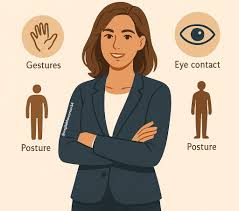
Body language speaks even when we don’t. In this dialogue, Tom and Jake explore how gestures like nodding, shrugging, or avoiding eye contact can change the meaning of what we say. They show how our “silent language” can express disagreement, confidence, or uncertainty without words.
Learning Flow in This Unit:
- Understand – listen to a dialogue and learn key vocabulary
- Practice – complete vocabulary exercises
- Use – apply the vocabulary in speaking and writing tasks
- Check – see the answers below the exercises
📖 Stage 1 – Understand the Vocabulary
1️⃣ Listening for the main idea
Listen to the dialogue and choose the best answer.
Focus on the general topic and main message of the conversation. Do not worry about understanding every word.
1. What do Tom and Jake say about body language showing disagreement and uncertainty?
2. How do they describe behaviors indicating deep thought and agreement?
3. What do Tom and Jake say about body language in showing respect, confidence, and managing confrontations?
Tom: Hey Jake, have you ever thought about how our body language can impact how we communicate with others?
Jake: Yeah, definitely! It’s like a silent language that speaks volumes.
Tom: Exactly! Like when someone shakes their head, it usually means they disagree or disapprove of something.
Jake: Yeah, it’s like a non-verbal way of saying “no.” And what about submissive behavior? When someone avoids eye contact and makes themselves small, it can show they’re feeling inferior or intimidated.
Tom: Absolutely. It’s like they’re trying to avoid conflict or confrontation. On the other hand, when someone shrugs their shoulders, it often means they’re unsure or indifferent about something.
Jake: Yeah, it’s like they’re saying, “I don’t know” or “It doesn’t matter to me.” And have you noticed how stroking one’s chin can indicate someone is deep in thought or pondering something?
Tom: Oh yeah, definitely. It’s like they’re considering their options or trying to come up with a solution. And when someone nods their head, it typically shows agreement or understanding.
Jake: Right, it’s like they’re saying “yes” without saying a word. And a firm handshake can convey confidence and authority.
Tom: Definitely. It’s like they’re asserting themselves right from the start. But what about body language related to femininity or masculinity?
Jake: Well, standing a respectful distance from someone can show politeness and consideration for their personal space, regardless of gender.
Tom: That makes sense. And when it comes to confrontation, body language can play a big role in how the situation unfolds.
Jake: Yeah, definitely. Avoiding eye contact or crossing arms can escalate tension, while open body language and calm gestures can help diffuse it.
Tom: Exactly. So, it’s important to be aware of our body language and how it can impact our interactions with others.
Jake: Absolutely. It’s like another tool in our communication toolbox.
2️⃣ Listening for details
Listen to the dialogue again and decide if the statements below are True or False.
This time, listen carefully for specific information, such as reasons, opinions, or examples mentioned by the speakers.
- Shaking the head is usually a sign of agreement.
- Avoiding eye contact can show that a person feels intimidated.
- Shrugging the shoulders means someone is confident.
- Stroking the chin can show that someone is thinking deeply.
- Nodding the head often means disagreement.
- A firm handshake can show confidence and authority.
- Standing too close to someone always shows respect.
- Crossing arms can sometimes increase tension in a confrontation.
- Open body language can help reduce conflict.
- Body language has no real effect on communication.
3️⃣ Vocabulary matching
Match the words or expressions with their correct definitions.
Read each word carefully and choose the definition that best explains its meaning in the context of the topic.
| 1. Impact | A. Communication without using words |
| 2. A silent language | B. To show disagreement by moving your head side to side |
| 3. Shake one’s head | C. To have a strong effect on something |
| 4. Disapprove of | D. To show that you think something is wrong or bad |
| 5. Non-verbal | E. Behaving in a quiet and less powerful way |
| 6. Submissive | F. To not look directly at someone’s eyes |
| 7. Avoid eye contact | G. Feeling less important or less good than others |
| 8. Inferior | H. A situation where people argue or face conflict |
| 9. Confrontation | I. To raise your shoulders to show you don’t know or don’t care |
| 10. Shrug one’s shoulders | J. Not certain or not sure about something |
| 11. Unsure | K. To touch your chin as a sign of thinking |
| 12. Stroke one’s chin | L. To think carefully about something |
| 13. Ponder | M. To move your head up and down to show agreement |
| 14. Nod one’s head | N. A strong and confident way of shaking hands |
| 15. A firm handshake | O. To express your opinions confidently |
| 16. Assert oneself | P. Qualities traditionally associated with being female |
| 17. Femininity | Q. Qualities traditionally associated with being male |
| 18. Masculinity | R. To keep polite physical space between yourself and others |
| 19. Stand a respectful distance | S. To fold your arms across your chest (often defensive) |
| 20. Cross one’s arms | T. Something you use to help you do a task |
| 21. A tool | U. A way of communicating without speaking (using body language) |
✏️ Stage 2 – Practice the Vocabulary
4️⃣ Gap fill
Complete the sentences using the words from the list.
Use each word once. Choose the word that best fits the meaning and grammar of the sentence.
impact • shake one’s head • disapprove of • non-verbal • submissive • avoid eye contact • inferior • confrontation • shrug one’s shoulders • unsure • stroke one’s chin • ponder • nod one’s head • a firm handshake • assert oneself • stand a respectful distance • cross one’s arms • a tool
- Body language can have a big __________ on how people understand you.
- If you __________, it usually means you disagree.
- Some people __________ rude behavior in public places.
- Facial expressions and gestures are forms of __________ communication.
- He looked very __________ and didn’t express his opinion.
- She tends to __________ when she feels nervous or shy.
- He felt __________ compared to his more experienced colleagues.
- The discussion turned into a heated __________.
- When he didn’t know the answer, he just __________.
- I’m __________ about what decision to make.
- He began to __________ while thinking about the problem.
- Take some time to __________ your options before choosing.
- She __________ to show that she agreed.
- He greeted everyone with __________.
- It’s important to __________ in a professional environment.
- Always __________ when talking to someone to show respect.
- Crossing your arms can make you look defensive, especially if you __________.
- Good communication is an important __________ in everyday life.
5️⃣ Collocations exercise
Some words often appear together in natural English. Choose the word that forms the correct expression.
impact • silent language • shake • disapprove • non-verbal • submissive • avoid • inferior • confrontation • shrug • unsure • stroke • ponder • nod • firm • assert • respectful • cross • tool
- have a big __________ on someone
- a __________ language
- __________ one’s head
- __________ of something/someone
- __________ communication
- __________ behaviour
- __________ eye contact
- feel __________ to others
- a heated __________
- __________ one’s shoulders
- feel __________ about something
- __________ one’s chin
- __________ an idea
- __________ one’s head
- a __________ handshake
- __________ oneself
- stand a __________ distance
- __________ one’s arms
- a useful __________
- __________ body language
6️⃣ Word forms exercise
Complete the table with the correct word forms.
Fill in the missing verb, noun, adjective, or adverb forms of the words.
| Verb | Adverb | Adjective | Noun |
| impact | |||
| disapprove | |||
| assert | |||
| ponder | |||
| confront | |||
| respect |
Use the correct form of the word in brackets.
- His words had a strong __________ on the audience.
- She looked at him __________ when she disagreed with the idea.
- The teacher spoke in a very __________ tone, so students felt confident.
- There was clear __________ in her voice when she refused the offer.
- He answered __________ during the interview, showing confidence.
- The situation quickly became __________ after the disagreement.
- She sat __________, thinking carefully about the problem.
- His __________ made it clear he didn’t understand the question.
- The manager handled the issue __________ to avoid conflict.
- His __________ helped him stay calm during the discussion.
7️⃣ Paraphrasing / sentence transformation
Rewrite the sentences using the word in brackets.
Keep the same meaning, but change the structure of the sentence.
This exercise helps you learn different ways to express the same idea.
- He disagrees with the decision. (disapprove)
- She didn’t look at him during the conversation because she felt nervous. (avoid eye contact)
- He is not sure about the answer. (unsure)
- She moved her shoulders to show she didn’t know. (shrug one’s shoulders)
- He thinks carefully before making decisions. (ponder)
- She nodded to show agreement. (nod one’s head)
- He greeted me in a very confident way. (firm handshake)
- She tries to express her opinion confidently. (assert oneself)
- He felt less important than the others in the group. (inferior)
- The situation between them became tense and argumentative. (confrontation)
8️⃣ Error correction
Each sentence contains one mistake. Find the mistake and correct it.
This exercise helps you improve accuracy and natural vocabulary use.
- He disapprove of the decision.
- She avoided to eye contact during the conversation.
- He is unsure of what to doing.
- She shrugged her shoulder when she didn’t know the answer.
- He was ponder about the problem for a long time.
- She nod her head to show agreement.
- He greeted me with a strongly handshake.
- She is very assertive herself in meetings.
- He felt more inferior than his colleagues.
- The situation turned into a confrontationly argument.
🗣️ Stage 3 – Use the Vocabulary
9️⃣ IELTS Speaking tasks.
Practice using new vocabulary in IELTS Speaking Parts 1-2-3:
Answer the questions using vocabulary from this unit.
Part 1 (4-5 minutes):
- What is your name? /give your full name: first name and last name/
- What shall I call you?
- Can I see your ID, please?
- Do you work or are you a student?
- Where do you work/ study?
- Do you like your job/ studies?
- If you had to change one thing about your job/ studies, what would you change? Why?
Let’s talk about drinks.
- What is your favourite drink? Why?
- Is it common for people to drink coffee or tea indoor country?
- Did you prefer different drinks as a child?
- Do you think it is important to drink a lot of water?
Let’s now discuss evenings.
- What do you often do in the evenings?
- Do you do the same thing every evening? Why or why not?
- Do you ever work or study in the evenings?
- 4. What is a popular activity for young people in your country in the evenings?
Part 2 (2-3 minutes):
Describe a situation when you understood someone’s feelings from their body language.
You should say:
- who the person was
- where you were
- what body language they used
- and explain how you understood their feelings
You have 1 minute to take notes. You should speak for 2 minutes.
Part 3 (5-6 minutes):
Answer the following questions. Give reasons and examples.
First, let’s consider the role of the body language in communication.
- How important is body language in communication?
- In what situations is body language more effective than words?
- Do you think people pay enough attention to body language? Why or why not?
- How can body language improve communication in professional settings?
Let’s now discuss the impact of body language on culture.
- Do people from different cultures use body language differently?
- Can body language be misunderstood? Can you give an example?
- How can people avoid misunderstandings caused by body language?
- Do you think globalization is changing the way people use body language? Why?
🔟IELTS Writing tasks
Task 1 (IELTS Academic Training): Write at least 150 words. You have 20 minutes to plan – write – proofread your task.
The chart below shows how different types of body language are interpreted in communication. Summarise the information by selecting and reporting the main features, and make comparisons where relevant.
| Body Language Type | Agreement (%) | Disagreement (%) | Uncertainty (%) | Confidence (%) |
| Nodding | 75 | 5 | 10 | 10 |
| Shaking head | 5 | 80 | 10 | 5 |
| Shrugging shoulders | 5 | 10 | 70 | 15 |
| Avoiding eye contact | 10 | 15 | 50 | 25 |
| Firm handshake | 10 | 5 | 5 | 80 |
💡 What to focus on:
- Give an overview (main trends)
- Compare high vs low percentages
- Highlight contrasts (e.g., nodding vs shaking head)
- Use formal language (e.g., “the majority,” “in contrast,” “whereas”)
Task 2: Write at least 250 words. You have 40 minutes to plan – write – proofread your task.
Some people believe that body language is more important than spoken words in communication. To what extent do you agree or disagree?
💡 What to include:
- Include relevant vocabulary (e.g., non-verbal communication, gestures, facial expressions, convey meaning)
- Clearly state your opinion (agree / disagree / partly agree)
- Give reasons and examples to support your ideas
- Use clear paragraphs (introduction, body, conclusion)
ANSWERS
EXERCISE 1:
1. What do Tom and Jake say about body language showing disagreement and uncertainty?
They say that shaking the head shows disagreement or disapproval, while shrugging the shoulders shows uncertainty or indifference. Avoiding eye contact and making oneself small can also show insecurity or discomfort.
2. How do they describe behaviors indicating deep thought and agreement?
They explain that stroking the chin shows deep thought, while nodding the head shows agreement or understanding.
3. What do Tom and Jake say about body language in showing respect, confidence, and managing confrontations?
They say that standing at a respectful distance shows politeness, and a firm handshake shows confidence and authority. In confrontations, closed body language like avoiding eye contact or crossing arms can increase tension, while open and calm body language can help reduce conflict.
EXERCISE 2:
- False – Shaking the head usually means disagreement, not agreement.
- True – Avoiding eye contact can show someone feels intimidated or uncomfortable.
- False – Shrugging the shoulders usually shows uncertainty or indifference, not confidence.
- True – Stroking the chin is often a sign that someone is thinking carefully.
- False – Nodding the head usually means agreement, not disagreement.
- True – A firm handshake is commonly associated with confidence and authority.
- False – Standing at a respectful distance (not too close) shows respect for personal space.
- True – Crossing arms can create a defensive impression and increase tension.
- True – Open body language (relaxed posture, open gestures) can help reduce conflict.
- False – Body language plays an important role in communication.
EXERCISE 3:
- C
- U
- B
- D
- A
- E
- F
- G
- H
- I
- J
- K
- L
- M
- N
- O
- P
- Q
- R
- S
- T
EXERCISE 4:
- impact
- shake one’s head
- disapprove of
- non-verbal
- submissive
- avoid eye contact
- inferior
- confrontation
- shrug one’s shoulders
- unsure
- stroke one’s chin
- ponder
- nod one’s head
- a firm handshake
- assert oneself
- stand a respectful distance
- cross one’s arms
- a tool
EXERCISE 5:
- impact
- silent language
- shake
- disapprove
- non-verbal
- submissive
- avoid
- inferior
- confrontation
- shrug
- unsure
- stroke
- ponder
- nod
- firm
- assert
- respectful
- cross
- tool
- non-verbal
EXERCISE 6:
| Verb | Adverb | Adjective | Noun |
| impact | impactfully | impactful | impact |
| disapprove | disapprovingly | disapproving | disapproval |
| assert | assertively | assertive | assertion |
| ponder | ponderingly (not used often) | pensive | pondering |
| confront | confrontationally | confrontational | confrontation |
| respect | respectfully | respectful | respect |
- impact
- disapprovingly
- assertive
- disapproval
- assertively
- confrontational
- pensive
- shaking
- respectfully
- avoidance
EXERCISE 7:
- He disapproves of the decision.
- She avoided eye contact because she felt nervous during the conversation.
- He is unsure about the answer.
- She shrugged her shoulders to show she didn’t know.
- He ponders before making decisions.
- She nodded her head to show agreement.
- He greeted me with a firm handshake.
- She tries to assert herself when expressing her opinion.
- He felt inferior to the others in the group.
- The situation turned into a confrontation.
EXERCISE 8:
- He disapproves of the decision.
- She avoided eye contact during the conversation.
- He is unsure of what to do.
- She shrugged her shoulders when she didn’t know the answer.
- He was pondering the problem for a long time.
- She nodded her head to show agreement.
- He greeted me with a firm handshake.
- She is very assertive in expressing herself in meetings.
- He felt inferior to his colleagues.
- The situation turned into a confrontation.

You may also like

Judging Character
Job Interviews (Part 1)