
Body Language 2
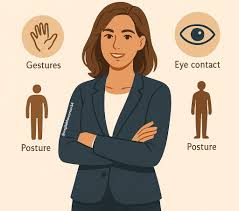
Body language speaks louder than words — in this unit, you’ll explore how people communicate beyond language through gestures, facial expressions, and posture. You’ll learn key vocabulary to describe body language and use it confidently in speaking, writing, listening, and reading. Build stronger real-life communication skills today!
Learning Flow in This Unit:
- Understand – listen to a dialogue and learn key vocabulary
- Practice – complete vocabulary exercises
- Use – apply the vocabulary in speaking and writing tasks
- Check – see the answers below the exercises
📖 Stage 1 – Understand the Vocabulary
1️⃣ Listening for the main idea
Listen to the dialogue and choose the best answer.
Focus on the general topic and main message of the conversation. Do not worry about understanding every word.
1. What do Maria and Sarah say about body language showing confidence and defensiveness?
2. How do they explain what nail-biting, stammering, and blushing can mean?
3. What do Maria and Sarah say about actions like rubbing eyes, covering mouths, and scratching heads during communication?
Maria: Hey Sarah, have you ever noticed how much our body language can affect the way we communicate?
Sarah: Oh, absolutely! Body language speaks volumes sometimes, doesn’t it?
Maria: Definitely! Like when someone stands with their arms behind their back, it can make them seem confident and in control.
Sarah: Yeah, it’s like they’re ready to take charge. But when someone crosses their arms, it often signals defensiveness or closed-off behavior.
Maria: Exactly! It’s like they’re putting up a barrier between themselves and the other person.
Sarah: And have you ever noticed how some people bite their nails when they’re nervous or anxious?
Maria: Oh, for sure! It’s like a telltale sign of their inner tension. And sometimes, people even stammer or stumble over their words when they’re really nervous.
Sarah: Yeah, it’s like their body is betraying their anxiety. And blushing! That’s another obvious giveaway of embarrassment or shyness.
Maria: Definitely. It’s like their cheeks give away their true feelings, even if they’re trying to hide them. Oh, and what about when someone rubs their eyes during a conversation?
Sarah: Yeah, it can indicate tiredness or even frustration. And when someone covers their gaping mouth with their hands, it usually means they’re shocked or surprised.
Maria: Right! It’s like they can’t believe what they just heard or saw. And scratching one’s head can signify confusion or trying to figure something out.
Sarah: Yeah, it’s like they’re literally scratching their head trying to find an answer. So, our body language really does speak volumes, doesn’t it?
Maria: Absolutely! It’s like a whole other layer of communication that we often don’t even realize we’re using.
2️⃣ Listening for details
Listen to the dialogue again and decide if the statements below are True or False.
This time, listen carefully for specific information, such as reasons, opinions, or examples mentioned by the speakers.
- Standing with arms behind the back can make a person appear confident.
- Crossing arms usually shows that a person is open and relaxed.
- Nail-biting is mentioned as a sign of nervousness or anxiety.
- People who are nervous may stammer or stumble over their words.
- Blushing is described as a sign of anger.
- Rubbing the eyes can indicate tiredness or frustration.
- Covering the mouth during a conversation usually shows excitement.
- Scratching the head can mean that someone is confused.
- Maria believes body language is not very important in communication.
- Sarah agrees that body language can communicate a lot without words.
3️⃣ Vocabulary matching
Match the words or expressions with their correct definitions.
Read each word carefully and choose the definition that best explains its meaning in the context of the topic.
| 1. speak volumes | A. a physical action showing leadership or authority |
| 2.arms behind one’s back | B. to hesitate or repeat sounds when speaking |
| 3. take charge of | C. a feeling of worry or nervousness |
| 4. cross one’s arms | D. to show emotions without intending to |
| 5. defensiveness | E. a sign that reveals something hidden |
| 6.closed-off | F. to feel or show that you are managing a situation well |
| 7.put up a barrier | G. to act as if protecting yourself from criticism or threat |
| 8. bite one’s nails | H. to create emotional distance from others |
| 9. anxious | I. a gesture showing confidence and authority |
| 10. inner tension | J. to fold your arms across your chest |
| 11. stammer | K. a physical habit linked to stress or nervousness |
| 12. blush | L. a visible reaction showing embarrassment |
| 13. a giveaway | M. something that communicates meaning beyond words |
| 14. give away one’s true feelings | N. to lead or take control of a situation |
| 15. rub one’s eyes | O. a hidden feeling of stress inside |
| 16. tiredness | P. to cover your open mouth in shock or surprise |
| 17. cover one’s gaping mouth | Q. to touch or move your eyes, often when tired or frustrated |
| 18. scratch one’s head | R. the state of being physically or mentally tired |
| 19. a layer of communication | S. to show confusion or deep thinking |
| 20. in control | T. an additional, non-verbal way of expressing meaning |
✏️ Stage 2 – Practice the Vocabulary
4️⃣ Gap fill
Complete the sentences using the words from the list.
Use each word once. Choose the word that best fits the meaning and grammar of the sentence.
speak volumes • take charge • cross one’s arms • defensiveness • closed-off • put up a barrier • anxious • inner tension • stammer • blush • a giveaway • give away one’s true feelings • rub one’s eyes • tiredness • cover one’s gaping mouth • scratch one’s head • a layer of communication
- His body language seemed very ________, and he didn’t want to talk to anyone.
- When people feel nervous, they sometimes ________ or hesitate while speaking.
- She started to ________ when everyone looked at her after the mistake.
- His constant nail-biting was a clear ________ that he was stressed.
- Non-verbal signals like gestures add another ________ to communication.
- Instead of listening, he chose to ________ and refuse to engage in the discussion.
- Her confident posture seemed to ________ about her leadership skills.
- When faced with a problem, a good leader will ________ and guide others.
- He began to ________ because he couldn’t understand the question.
- She tried not to ________, but her face turned red anyway.
- Rubbing your eyes during a conversation can show ________ or frustration.
- Some people ________ when they feel uncomfortable or worried.
- His silence and posture seemed to ________ between him and the group.
- Even if you try to hide it, your expressions can ________.
- She felt a lot of ________ before giving her presentation.
- Crossing your arms may signal ________ in a conversation.
- He had a lot of ________, even though he tried to appear calm.
5️⃣ Collocations exercise
Some words often appear together in natural English. Choose the word that forms the correct expression.
charge • arms • barrier • volumes • nails • head • eyes • mouth • feelings • tension
- speak ________
- cross one’s ________
- take ________
- put up a ________
- bite one’s ________
- scratch one’s ________
- rub one’s ________
- cover one’s ________
- give away one’s true ________
- inner ________
6️⃣ Word forms exercise
Complete the table with the correct word forms.
Fill in the missing verb, noun, adjective, or adverb forms of the words.
| Verb | Adverb | Adjective | Noun |
| communicate | |||
| express | |||
| react | |||
| control | |||
| confuse | |||
| embarrass | |||
| — | anxious |
Use the correct form of the word in brackets.
- Body language is an important form of __________ (communicate).
- She is very __________ (express) and shows her feelings clearly.
- His nervous __________ (react) made the situation more awkward.
- He tried to remain calm and __________ (control) during the meeting.
- I was really __________ (confuse) by his body language.
- It was an __________ (embarrass) moment when she forgot her lines.
- She spoke __________ (express) to show her excitement.
- His __________ (communicate) skills are excellent.
- The instructions were __________ (confuse), so many people made mistakes.
- He felt __________ (embarrass) when everyone looked at him.
- She felt very __________ (anxiety) before her presentation.
- He looked around __________ (anxious) while waiting for the results.
7️⃣ Paraphrasing / sentence transformation
Rewrite the sentences using the word in brackets.
Keep the same meaning, but change the structure of the sentence.
This exercise helps you learn different ways to express the same idea.
- His body language showed that he was very confident. (volumes)
→ His body language ______________________________. - She became red in the face when everyone looked at her. (blush)
→ She ______________________________ when everyone looked at her. - He crossed his arms because he didn’t want to communicate. (closed-off)
→ He crossed his arms because he ______________________________. - It was obvious that he was nervous from his behavior. (giveaway)
→ His behavior ______________________________. - She tried to hide her emotions, but people could still see them. (give away)
→ She tried not to ______________________________. - He took control of the situation immediately. (charge)
→ He ______________________________ of the situation immediately. - His gestures added more meaning to his words. (layer)
→ His gestures added another ______________________________. - She felt very nervous before the presentation. (anxious)
→ She ______________________________ before the presentation. - He hesitated and repeated sounds while speaking. (stammer)
→ He ______________________________ while speaking. - His actions created distance between him and others. (barrier)
→ His actions ______________________________.
8️⃣ Error correction
Each sentence contains one mistake. Find the mistake and correct it.
This exercise helps you improve accuracy and natural vocabulary use.
- His body language speak volumes about his confidence.
- She were very anxious before her presentation.
- He crossed his arms because he felt very open to discussion.
- Her reaction was a clear giveaway of she was nervous.
- He stammering when he tried to explain the situation.
- She blushed because everyone was looking at she.
- His actions put a barrier between he and the group.
- She felt very confuse during the conversation.
- Rubbing eyes can show tiredness or frustration.
- He took charge of the situation immediately and calm everyone down.
🗣️ Stage 3 – Use the Vocabulary
9️⃣ IELTS Speaking tasks.
Practice using new vocabulary in IELTS Speaking Parts 1-2-3:
Answer the questions using vocabulary from this unit.
Part 1 (4-5 minutes):
- What is your name? /give your full name: first name and last name/
- What shall I call you?
- Can I see your ID, please?
- Do you work or are you a student?
- Where do you work/ study?
- Do you like your job/ studies?
- If you had to change one thing about your job/ studies, what would you change? Why?
Let’s talk about dictionaries.
- Do you use a dictionary? Why or why not?
- What kind of dictionaries do you find most useful? Why?
- Why do people use online dictionaries?
Let’s now consider drinks.
- What is your favourite drink?
- Is it more common to drink tea or coffee in your home city?
- What drinks did you like as a child?
- What is a traditional drink in your country for celebrations?
Part 2 (2-3 minutes):
Describe a situation when you noticed someone’s body language clearly showing how they felt.
You should say:
- who the person was
- where and when it happened
- what body language they used
- and explain how their body language helped you understand their feelings
You have 1 minute to take notes. You should speak for 2 minutes.
Part 3 (5-6 minutes):
Answer the following questions. Give reasons and examples.
First, let’s consider body language in general.
- How important is body language in communication?
- Do you think people are good at understanding body language? Why or why not?
- Can body language be controlled or hidden?
- Are people in your country good at reading body language?
Let’s now discuss the impact of body language on our modern life.
- How does body language affect first impressions?
- Has digital communication reduced the importance of body language?
- Do you think people rely too much on words and ignore body language?
- How can body language help in job interviews or professional situations?
🔟IELTS Writing tasks
Task 1 (IELTS General Training): Write at least 150 words. You have 20 minutes to plan – write – proofread your task.
You recently attended a workshop on communication skills at a training centre. However, you were not satisfied with the experience.
Write a letter to the manager of the training centre. In your letter:
- explain why you attended the workshop
- describe what you did not like about it
- suggest how the workshop could be improved in the future
✍️ Suggested Approach:
Paragraph 1 – Opening
- Say why you are writing
- Rephrase the task politely
👉 “I am writing to express my dissatisfaction with…”
Paragraph 2 – First bullet point
- Explain the first reason clearly
- Add one example or detail
Paragraph 3 – Second bullet point
- Describe the problem or situation
- Be specific and logical
Paragraph 4 – Final point + closing
- Make suggestions or requests
- End politely
Task 2: Write at least 250 words. You have 40 minutes to plan – write – proofread your task.
Some people believe that communication is mostly about the words we use.
Others believe that body language is equally or even more important than spoken language.
Discuss both views and give your own opinion.
Suggested Approach:
✍️ Essay Plan
Paragraph 1 – Introduction
- Paraphrase the topic
- Mention both views
- Give your opinion (clear but not too detailed)
Paragraph 2 – View 1
- Explain first opinion
- Give reason + example
- Stay neutral (don’t argue yet)
Paragraph 3 – View 2
- Explain second opinion
- Use examples (body language, communication, real life)
Paragraph 4 – Conclusion
- Summarise both sides briefly
- Restate your opinion clearly
ANSWERS
EXERCISE 1:
1. What do Maria and Sarah say about body language showing confidence and defensiveness?
They say that standing with arms behind the back can make a person appear confident and in control, while crossing arms often shows defensiveness or that someone is closed off, as if creating a barrier.
2. How do they explain what nail-biting, stammering, and blushing can mean?
They explain that nail-biting is a sign of nervousness or anxiety. Stammering or stumbling over words also shows nervousness, as if the body is revealing inner tension. Blushing is described as a clear sign of embarrassment or shyness.
3. What do Maria and Sarah say about actions like rubbing eyes, covering mouths, and scratching heads during communication?
They say that rubbing the eyes can indicate tiredness or frustration. Covering the mouth (especially when open) suggests shock or surprise. Scratching the head shows confusion or that someone is trying to figure something out.
EXERCISE 2:
- True
Standing with arms behind the back is said to make a person appear confident and in control. - False
Crossing arms is described as a sign of defensiveness or being closed off—not open and relaxed. - True
Nail-biting is clearly mentioned as a sign of nervousness or anxiety. - True
They explain that nervous people may stammer or stumble over their words. - False
Blushing is linked to embarrassment or shyness, not anger. - True
Rubbing the eyes can show tiredness or frustration. - False
Covering the mouth is associated with shock or surprise, not excitement. - True
Scratching the head is described as a sign of confusion or trying to figure something out. - False
Maria says body language affects communication a lot, so she clearly thinks it is important. - True
Sarah agrees that body language “speaks volumes,” meaning it communicates a lot without words.
EXERCISE 3:
1–M
2–I
3–N
4–J
5–G
6–H
7–H
8–K
9–C
10–O
11–B
12–L
13–E
14–D
15–Q
16–R
17–P
18–S
19–T
20–F
EXERCISE 4:
- closed-off
- stammer
- blush
- a giveaway
- a layer of communication
- cross one’s arms
- speak volumes
- take charge
- scratch one’s head
- blush (Note: repetition is natural here)
- tiredness
- rub one’s eyes
- put up a barrier
- give away one’s true feelings
- anxious
- defensiveness
- inner tension
EXERCISE 5:
- volumes
- arms
- charge
- barrier
- nails
- head
- eyes
- mouth
- feelings
- tension
EXERCISE 6:
| Verb | Adverb | Adjective | Noun |
| communicate | communicatively | communicative | communication |
| express | expressively | expressive | expression |
| react | reactively | reactive | reaction |
| control | — | controlled | control |
| confuse | confusingly | confused / confusing | confusion |
| embarrass | embarrassingly | embarrassed / embarrassing | embarrassment |
| — | anxiously | anxious | anxiety |
- communication
- expressive
- reaction
- controlled
- confused
- embarrassing
- expressively
- communication
- confusing
- embarrassed
- anxious
- anxiously
EXERCISE 7:
- His body language spoke volumes about his confidence.
- She blushed when everyone looked at her.
- He crossed his arms because he was closed-off.
- His behavior was a clear giveaway that he was nervous.
- She tried not to give away her true feelings.
- He took charge of the situation immediately.
- His gestures added another layer of communication.
- She felt anxious before the presentation.
- He stammered while speaking.
- His actions put up a barrier between him and others.
EXERCISE 8:
- His body language speaks volumes about his confidence.
- She was very anxious before her presentation.
- He crossed his arms because he felt very closed-off to discussion.
- Her reaction was a clear giveaway that she was nervous.
- He stammered when he tried to explain the situation.
- She blushed because everyone was looking at her.
- His actions put a barrier between him and the group.
- She felt very confused during the conversation.
- Rubbing one’s eyes can show tiredness or frustration.
- He took charge of the situation immediately and calmed everyone down.

You may also like

Judging Character
Job Interviews (Part 1)