Book Genres
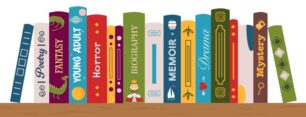
Books can reveal a lot about who we are. In this dialogue, Tom and John discuss their favourite genres, share opinions on fiction and non-fiction, and discover how stories can inspire imagination and emotional connection. Start practising now!
Learning Flow in This Unit:
- Understand – listen to a dialogue and learn key vocabulary
- Practice – complete vocabulary exercises
- Use – apply the vocabulary in speaking and writing tasks
- Check – see the answers below the exercises
📖 Stage 1 – Understand the Vocabulary
1️⃣ Listening for the main idea
Listen to the dialogue and choose the best answer.
Focus on the general topic and main message of the conversation. Do not worry about understanding every word.
- What are Tom and John mainly talking about?
- What genres does Tom like?
- What genres does John like?
- What do they agree to do at the end of their conversation?
Tom: Hey John, how’s it going?
John: Hey Tom, good to see you! Not much, just grabbing a coffee. How about you?
Tom: Same here. I’ve been reading a lot lately, actually. You into books?
John: Yeah, I enjoy reading too. What genres are you into?
Tom: Well, I’m a big fan of poetry. There’s something about the rhythm and emotion that really speaks to me. How about you?
John: Poetry, huh? I’m more of a novel person. The longer, the better.
Tom: Nice! Novels are great. Any specific type of novels you like?
John: I’m a sucker for fiction, especially mystery and thriller novels. I love the suspense and trying to solve the puzzle before the characters do.
Tom: Interesting choice! I do enjoy a good mystery too, but lately, I’ve been getting into science fiction. The imaginative worlds just captivate me.
John: Science fiction, huh? Not my cup of tea, but to each their own. How about non-fiction?
Tom: Oh, I love non-fiction, especially biographies. Learning about real people’s lives and their journeys is fascinating.
John: Totally! Personally, I prefer a bit of romance in my non-fiction, you know? Real-life love stories and all that.
Tom: That’s sweet. Romance isn’t usually my go-to, but I get the appeal. By the way, have you ever tried Young Adult fiction?
John: Yeah, I’ve read a few Young Adult novels. They can be surprisingly deep and relatable, even for us adults.
Tom: Totally agree. It’s impressive how those books can tackle real issues in a way that resonates with everyone. So, any genres you don’t like?
John: Not a big fan of romance novels, to be honest. I find them a bit too predictable.
Tom: Fair enough. For me, it’s probably horror. I can’t handle the suspense and jump scares.
John: Yeah, horror isn’t for everyone. Anyway, got any book recommendations? I’m always looking for something new to read.
Tom: Absolutely! I’ve got a poetry collection I think you might like. And I’ve been eyeing this biography that seems pretty intriguing.
John: Sounds good, man! Let’s swap recommendations.
2️⃣ Listening for details
Listen to the dialogue again and decide if the statements below are True or False.
This time, listen carefully for specific information, such as reasons, opinions, or examples mentioned by the speakers.
- Tom and John meet while having lunch together.
- Tom says that poetry speaks to him because of its rhythm and emotion.
- John prefers short novels to long ones.
- John especially enjoys mystery and thriller fiction.
- Tom has recently become interested in science fiction.
- John says that science fiction is his favourite genre.
- Tom enjoys reading biographies because he likes learning about real people’s lives.
- John enjoys romance novels very much.
- Both men think that Young Adult fiction can be meaningful for adults too.
- Tom dislikes horror because he cannot handle suspense and jump scares.
- John asks Tom for some new book recommendations.
- At the end of the conversation, they decide to watch a movie together.
3️⃣ Vocabulary matching
Match the words or expressions with their correct definitions.
Read each word carefully and choose the definition that best explains its meaning in the context of the topic.
| 1. A genre | A. A book or story about imagined future worlds, technology, or space |
| 2. Poetry | B. A strong feeling of excitement or nervousness about what will happen next |
| 3. A novel | C. A sudden frightening moment that surprises you |
| 4. Fiction | D. A type or category of books, films, or music |
| 5. Mystery | E. Stories or books that are invented, not real |
| 6. A thriller | F. A long fictional story written as a book |
| 7. Suspence | G. A story focused on love and relationships |
| 8. Science-fiction | H. To understand why people like something |
| 9. Non-fiction | I. A book or text written in poems |
| 10. A biography | J. A story designed to scare people |
| 11. Romance | K. Books for teenagers and young adults |
| 12. Go-to | L. A story with danger, excitement, and tension |
| 13. To get the appeal | M. A story about solving a crime or puzzle |
| 14. YA fiction | N. Books or writing based on real facts and people |
| 15. To tackle real issues | O. A book about a real person’s life |
| 16. Horror | P. Something you usually choose or prefer first |
| 17. A jump scare | Q. To discuss or deal with important social or personal problems |
| 18. To eye something | R. To look at something with interest because you may want it |
✏️ Stage 2 – Practice the Vocabulary
4️⃣ Gap fill
Complete the sentences using the words from the list.
Use each word once. Choose the word that best fits the meaning and grammar of the sentence.
genre • poetry • novel • fiction • mystery • thriller • suspense • science fiction • non-fiction • biography • romance • go-to • get the appeal • YA fiction • tackle real issues • horror • jump scare • eyeing
- My favourite book __________ is fantasy because I love magical worlds and adventures.
- Emily enjoys reading __________ because she loves poems with strong emotions and rhythm.
- He is writing a __________ about a detective solving crimes in London.
- Most superhero movies are examples of __________ because the characters are imaginary.
- The police could not solve the __________ until the very end of the story.
- This __________ kept me awake all night because it was so exciting and intense.
- The movie created a lot of __________ before revealing who the killer was.
- My brother loves __________ stories about aliens and futuristic technology.
- I usually read __________ books because I enjoy learning real facts.
- She is reading a __________ about the life of a famous singer.
- Anna enjoys __________ novels with happy endings and love stories.
- Coffee is my __________ drink when I need energy in the morning.
- I don’t usually like comics, but I can __________ after reading this one.
- Many teenagers enjoy __________ because the characters are relatable and realistic.
- Good books can __________ such as bullying, mental health, or friendship problems.
- I never watch __________ movies because they scare me too much.
- There was a loud __________ in the film that made everyone scream.
- I’ve been __________ that new fantasy series at the bookstore for weeks.
5️⃣ Collocations exercise
Some words often appear together in natural English. Choose the word that forms the correct expression.
solve • real • book • jump • science • love • suspense • favourite • swap • emotional
- __________ fiction
- __________ stories
- __________ recommendations
- __________ issues
- __________ scare
- __________ the puzzle
- __________ connection
- __________ novel
- __________ and tension
- __________ poetry
6️⃣ Word forms exercise
Complete the table with the correct word forms.
Fill in the missing verb, noun, adjective, or adverb forms of the words.
| verb | adverb | adjective | Noun |
| Imagine | |||
| Fascinate | |||
| Relate | |||
| Surprise | |||
| Predict | |||
| Captivate |
Use the correct form of the word in brackets.
- Science fiction writers use a lot of __________ to create new worlds and technologies.
- I found the documentary absolutely __________ because I learned many unusual facts.
- The main character was very __________, so many teenagers connected with her problems.
- The ending of the movie was completely __________ — I did not expect it at all.
- Romance novels can sometimes feel too __________ because the endings are often similar.
- The speaker talked so __________ that everyone listened carefully.
- Children often think very __________ and come up with original ideas.
- The mystery novel created a strong sense of __________ among readers.
- His life story was so interesting that it completely __________ the audience.
- Nobody could make an accurate __________ about who the criminal was.
7️⃣ Paraphrasing / sentence transformation
Rewrite the sentences using the word in brackets.
Keep the same meaning, but change the structure of the sentence.
This exercise helps you learn different ways to express the same idea.
- I really enjoy reading mystery novels.
(big fan) - Science fiction does not really interest John.
(cup) - These books discuss important problems teenagers face.
(tackle) - I usually choose biographies when I want to read non-fiction.
(go-to) - The story was exciting because nobody knew what would happen next.
(suspense) - I understand why people enjoy romance novels.
(appeal) - The characters in YA fiction are often easy to connect with.
(relatable) - Tom recently became interested in science fiction.
(getting into) - The horror movie frightened me several times with sudden scary moments.
(jump scares) - She is interested in buying that new poetry collection.
(eyeing)
8️⃣ Error correction
Each sentence contains one mistake. Find the mistake and correct it.
This exercise helps you improve accuracy and natural vocabulary use.
- Tom is very interested on poetry and biographies.
- John enjoys read mystery and thriller novels.
- Science fiction books can be very imagination.
- I don’t really get the appealing of horror movies.
- She has been eye that new romance novel for weeks.
- Young Adult fiction often tackle important social issues.
- The ending of the story was very suspense.
- I usually prefer non-fictions because I like real stories.
- That biography was so fascinate that I finished it in one day.
- Romance novels are too predictably for John.
🗣️ Stage 3 – Use the Vocabulary
9️⃣ IELTS Speaking tasks.
Practice using new vocabulary in IELTS Speaking Parts 1-2-3:
Answer the questions using vocabulary from this unit.
Part 1 (4-5 minutes):
- What is your name? /give your full name: first name and last name/
- What shall I call you?
- Can I see your ID, please?
- Do you work or are you a student?
- Where do you work/ study?
- Do you like your job/ studies?
- If you had to change one thing about your job/ studies, what would you change? Why?
Let’s talk about computers.
- Do you have a computer?
- Do often use a computer? Why or why not?
- Do you prefer desktops or laptops?
- What do you use your computer for?
Let’s now discuss childhood..
- Did you enjoy your childhood?
- What is the first memory of your childhood?
- Did you have a lot of friends when you were a child?
- What did you enjoy doing as a child?
Part 2 (2-3 minutes):
Describe a book or type of book that you really enjoy reading.
You should say:
- what kind of book it is
- how you became interested in it
- what you like about it
- and explain why this book or genre is important to you.
You have 1 minute to take notes. You should speak for 2 minutes.
Part 3 (5-6 minutes):
Answer the following questions. Give reasons and examples.
First, let’s consider reading habits.
- Why do different people enjoy different genres of books?
- Do you think people read less nowadays than in the past? Why?
- What are the advantages of reading fiction compared to non-fiction?
Let’s now discuss books and society in general.
- How can books help people understand real-life issues?
- Do you think schools should encourage teenagers to read more? Why or why not?
- In the future, do you think printed books will disappear completely? Why?
🔟IELTS Writing tasks
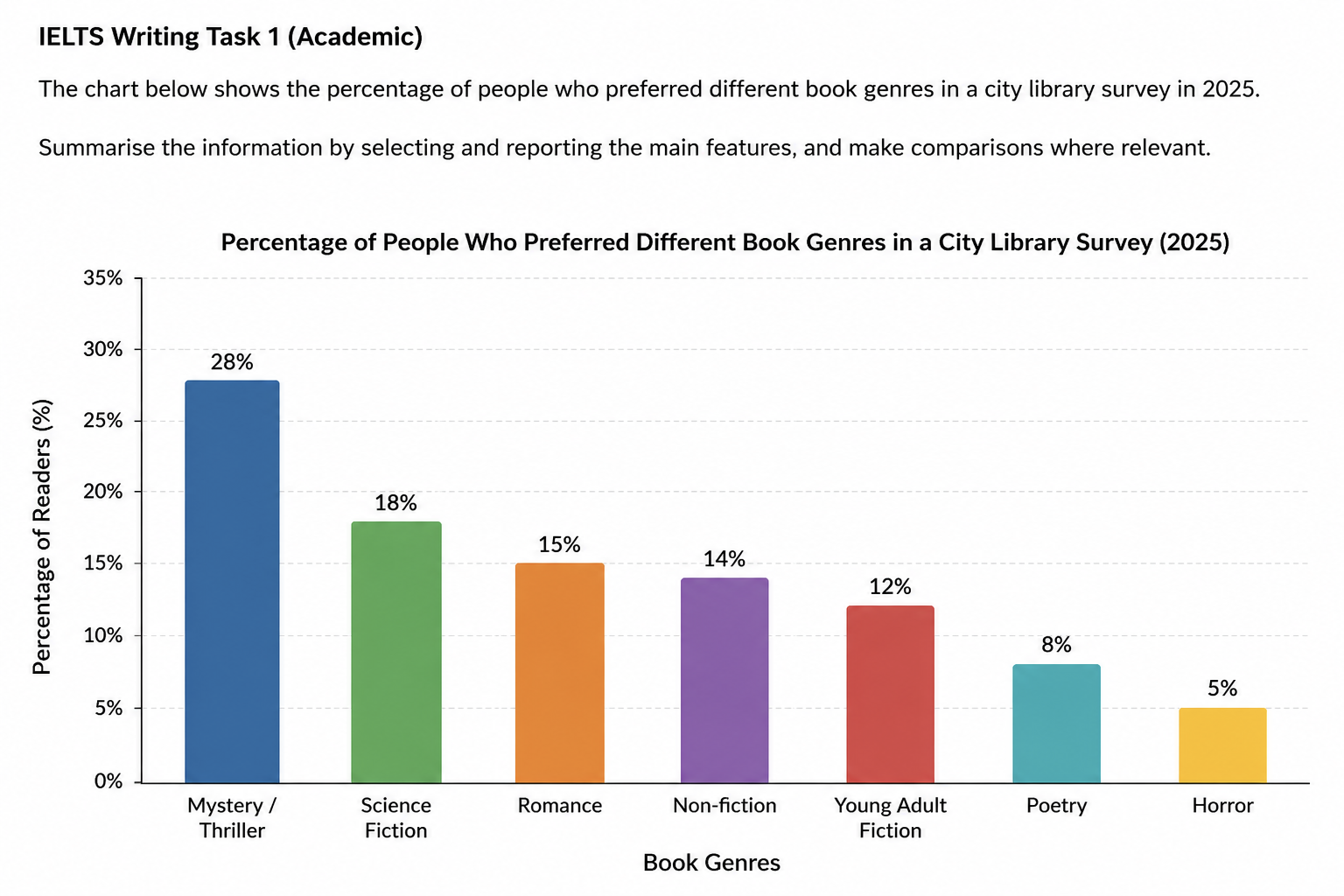
Task 1 (IELTS Academic Training): Write at least 150 words. You have 20 minutes to plan – write – proofread your task.
💡 What to focus on:
- Give an overview (main trends)
- Group and compare high vs low percentages
- Highlight contrasts
- Use formal language (e.g., “the majority,” “in contrast,” “whereas”)
Task 2: Write at least 250 words. You have 40 minutes to plan – write – proofread your task.
Some people believe that reading fiction books is more beneficial because it develops imagination and creativity. Others think that reading non-fiction is more useful because it provides real-world knowledge and practical information.
Compare and contrast these two views and give your own opinion.
💡 What to include:
- Include relevant vocabulary (e.g., non-verbal communication, gestures, facial expressions, convey meaning)
- Clearly state your opinion (agree / disagree / partly agree)
- Give reasons and examples to support your ideas
- Use clear paragraphs (introduction, body, conclusion)
ANSWERS
EXERCISE 1:
- Tom and John are mainly talking about books and reading preferences.
- Tom likes:
- poetry
- science fiction
- non-fiction, especially biographies
- Young Adult fiction
- John likes:
- novels
- fiction, especially mystery and thriller novels
- romance in non-fiction
- Young Adult fiction
- At the end of the conversation, they agree to swap book recommendations.
EXERCISE 2:
- False
They meet while grabbing a coffee, not having lunch. - True
Tom says poetry speaks to him because of “the rhythm and emotion.” - False
John says, “The longer, the better,” so he prefers long novels. - True
John says he enjoys mystery and thriller novels because he likes the suspense. - True
Tom says that lately he has been getting into science fiction. - False
John says science fiction is “not my cup of tea,” meaning he does not really like it. - True
Tom enjoys biographies because he finds real people’s lives and journeys fascinating. - False
John says he is not a big fan of romance novels because they are too predictable. - True
Both speakers agree that Young Adult fiction can be deep, relatable, and meaningful for adults. - True
Tom says he cannot handle “the suspense and jump scares” in horror stories. - True
John asks, “Got any book recommendations?” - False
They decide to swap book recommendations, not watch a movie together.
EXERCISE 3:
1 — D
2 — I
3 — F
4 — E
5 — M
6 — L
7 — B
8 — A
9 — N
10 — O
11 — G
12 — P
13 — H
14 — K
15 — Q
16 — J
17 — C
18 — R
EXERCISE 4:
- genre
- poetry
- novel
- fiction
- mystery
- thriller
- suspense
- science fiction
- non-fiction
- biography
- romance
- go-to
- get the appeal
- YA fiction
- tackle real issues
- horror
- jump scare
- eyeing
EXERCISE 5:
- science fiction
- love stories
- book recommendations
- real issues
- jump scare
- solve the puzzle
- emotional connection
- favourite novel
- suspense and tension
- emotional poetry
EXERCISE 6:
| verb | adverb | adjective | Noun |
| Imagine | imaginatively | imaginative | imagination |
| Fascinate | fascinatingly | fascinating | fascination |
| Relate | relatably | relatable | relation / relatability* |
| Surprise | surprisingly | surprising | surprise |
| Predict | predictably | predictable | prediction |
| Captivate | captivatingly | captivating | captivation |
*relatability is not common in everyday language
- imagination
- fascinating
- relatable
- surprising
- predictable
- captivatingly
- imaginatively
- fascination
- captivated
- prediction
EXERCISE 7:
- I am a big fan of mystery novels.
- Science fiction is not John’s cup of tea.
- These books tackle real issues teenagers face.
- Biographies are my go-to non-fiction books.
- The story was exciting because it created a lot of suspense.
- I get the appeal of romance novels.
- The characters in YA fiction are often relatable.
- Tom has recently been getting into science fiction.
- The horror movie frightened me with several jump scares.
- She has been eyeing that new poetry collection.
EXERCISE 8:
- Tom is very interested in poetry and biographies.
- John enjoys reading mystery and thriller novels.
- Science fiction books can be very imaginative.
- I don’t really get the appeal of horror movies.
- She has been eyeing that new romance novel for weeks.
- Young Adult fiction often tackles important social issues.
- The ending of the story was very suspenseful.
- I usually prefer non-fiction because I like real stories.
- That biography was so fascinating that I finished it in one day.
- Romance novels are too predictable for John.

You may also like